Findings
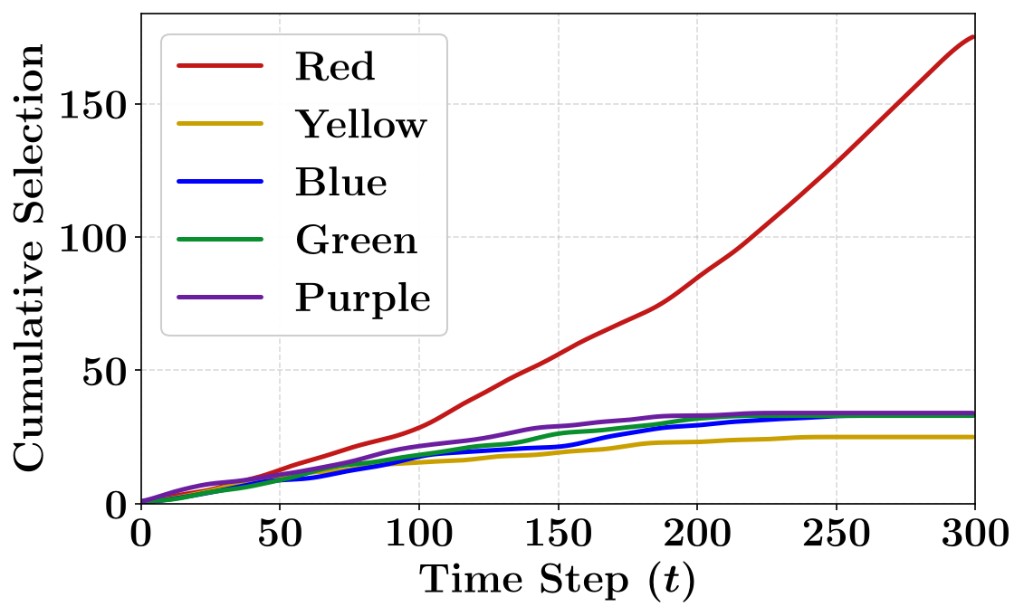
DORA explores early in MAB and converges quickly to the optimal arm.
Arms selected by DORA over a single episode. In the early timesteps the λ policy samples all arms, and as t grows λ increases and the agent shifts to exploiting the optimal arm (red).
Cumulative regret across methods over a horizon of T = 500. DORA’s λexp schedule approaches classical baselines (UCB, TS), while a greedy LLM (τ = 0) accumulates substantially higher regret.
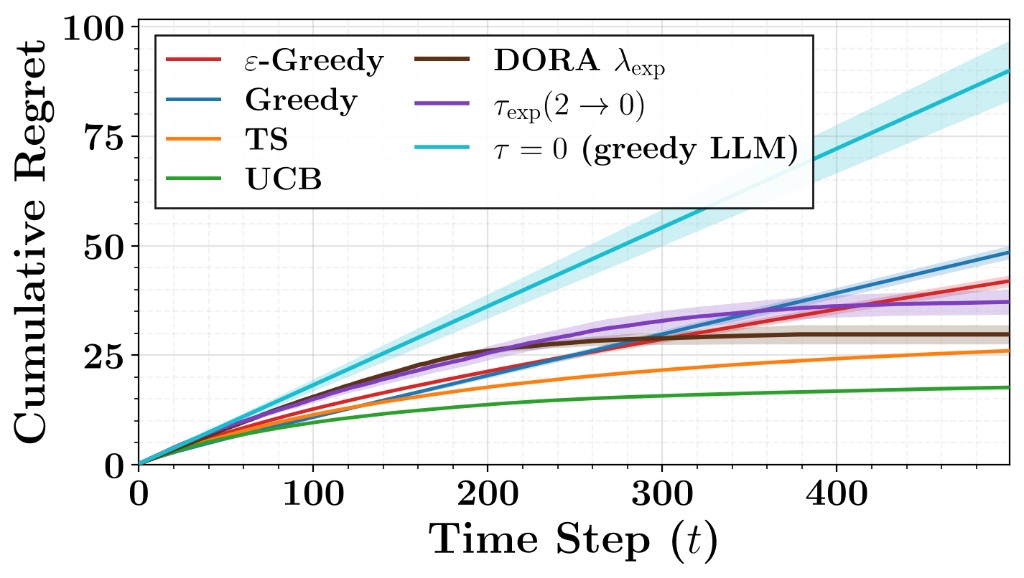
DORA achieves near-optimal performance on Multi-Armed Bandits.
Multi-Armed Bandits (MAB) provide a classical testbed for the exploration–exploitation trade-off. We study the Bernoulli instance with K=5 arms, gap Δ=0.2, and horizon T=500. For τ ≤ 1, the model behaves overly greedily, often committing early to a suboptimal arm (suffix failure up to 90%). For τ > 1, increased randomness prevents consistent exploitation. DORA explores effectively in early stages and rapidly converges to the optimal arm, achieving zero Suffix Failure Frequency and approaching the near-optimal UCB baseline.
| Metric | UCB | TS | Greedy | ε-Greedy | τ=0 | τ=0.7 | τ=1 | τ=1.5 | τexp | DORA λexp |
|---|---|---|---|---|---|---|---|---|---|---|
| Mean Avg Reward | 0.564 | 0.548 | 0.503 | 0.509 | 0.414 | 0.414 | 0.422 | 0.518 | 0.484 | 0.538 |
| SuffFailFreq(T/2) | 0.011 | 0.000 | 0.465 | 0.230 | 0.900 | 0.900 | 0.850 | 0.000 | 0.000 | 0.000 |
| Best Arm Fraction | 0.824 | 0.743 | 0.515 | 0.550 | 0.100 | 0.100 | 0.131 | 0.675 | 0.698 | 0.703 |
| Cum Regret | 17.637 | 25.686 | 48.502 | 44.998 | 90.000 | 90.000 | 86.900 | 34.640 | 37.160 | 28.730 |
Table 1. Performance on the Bernoulli MAB instance using Llama-3.1 8B with horizon T=500. UCB, TS, Greedy, and ε-greedy are averaged over N=1000 runs; LLM-based methods are averaged over N=20 runs.
DORA improves overall task success on TALES.
DORA visits over 2× more unique states in TextWorld and ScienceWorld, enabling discovery of hidden objects and task-relevant signals. By enabling agents to discover new information and avoid repetitive loops, DORA leads to consistent performance gains across all TALES environments, including measurable progress in AlfWorld where feedback is sparse and unhelpful.
| Model | Setting | TextWorld | TW Express | AlfWorld | ScienceWorld | Jericho |
|---|---|---|---|---|---|---|
| Qwen-2.5 7B | Zero-shot | 29.20±1.92 | 48.93±1.69 | 0.00±0.00 | 13.49±0.12 | 0.66±0.04 |
| Chain of Thought | 24.89±0.91 | 37.44±0.00 | 0.00±0.00 | 9.81±0.18 | 1.58±0.03 | |
| Tree of Thought | 11.39±0.83 | 45.90±0.21 | 0.00±0.00 | 10.10±0.00 | 1.40±0.00 | |
| Prompt Explore | 23.12±1.29 | 47.81±0.00 | 0.00±0.00 | 13.21±0.34 | 1.27±0.04 | |
| ReAct | 31.43±3.16 | 39.50±0.62 | 2.78±2.78 | 9.92±0.62 | 1.87±0.25 | |
| DORA (Ours) | 45.40±1.68 | 51.17±3.38 | 2.78±2.78 | 19.01±0.62 | 1.42±0.24 | |
| Llama-3.1 8B | Zero-shot | 40.74±0.67 | 48.29±1.04 | 0.00±0.00 | 15.53±0.50 | 2.21±0.14 |
| Chain of Thought | 37.72±1.16 | 24.72±2.50 | 0.00±0.00 | 7.81±0.87 | 2.22±0.22 | |
| Tree of Thought | 15.06±0.69 | 15.52±0.21 | 0.00±0.00 | 8.64±1.64 | 2.05±0.15 | |
| Prompt Explore | 43.07±0.72 | 52.77±2.08 | 0.00±0.00 | 13.70±0.59 | 1.60±0.21 | |
| ReAct | 22.92±5.04 | 60.38±1.95 | 0.00±0.00 | 15.94±2.34 | 2.88±0.51 | |
| DORA (Ours) | 50.15±6.88 | 52.89±3.51 | 2.78±2.78 | 16.85±0.58 | 2.17±0.21 | |
| Mistral Small 22B | Zero-shot | 62.25±1.08 | 31.70±2.08 | 0.00±0.00 | 26.47±0.57 | 1.35±0.03 |
| Chain of Thought | 31.43±2.22 | 25.16±0.28 | 0.00±0.00 | 9.63±0.35 | 1.43±0.13 | |
| Tree of Thought | 32.54±0.83 | 26.40±1.71 | 0.00±0.00 | 10.88±0.85 | 1.27±0.03 | |
| Prompt Explore | 50.60±0.69 | 42.46±0.79 | 0.00±0.00 | 21.48±0.48 | 1.70±0.05 | |
| ReAct | 57.78±5.47 | 23.54±2.07 | 0.00±0.00 | 26.70±4.19 | 3.37±0.02 | |
| DORA (Ours) | 74.28±2.99 | 43.12±1.21 | 2.78±2.78 | 32.43±1.15 | 2.92±0.66 | |
| Llama-3.1 70B | Zero-shot | 63.95±2.00 | 82.25±0.75 | 11.11±5.56 | 54.35±1.29 | 5.17±0.10 |
| Chain of Thought | 61.29±0.00 | 80.23±1.88 | 5.56±5.56 | 45.23±2.05 | 5.37±0.17 | |
| Tree of Thought | 67.03±4.55 | 48.73±3.70 | 0.00±0.00 | 28.32±3.47 | 3.31±0.44 | |
| Prompt Explore | 61.95±1.15 | 83.87±3.12 | 0.00±0.00 | 52.51±3.61 | 5.57±0.19 | |
| ReAct | 57.03±4.42 | 70.60±3.37 | 16.67±0.00 | 44.79±1.47 | 4.72±0.37 | |
| DORA (Ours) | 71.12±2.24 | 85.33±0.73 | 16.67±0.00 | 63.40±2.62 | 5.22±0.09 |
Table 2. Performance of DORA compared to baseline prompting strategies on TALES environments. Results report mean normalised scores across tasks ± standard error over 3 runs.
DORA enables loop recovery with 5× to 20× higher rates.
Baseline methods frequently enter loops and rarely recover (below 1%). DORA substantially reduces loops encountered and achieves 5× to 20× higher recovery rates across all TALES environments.
| Method | TextWorld | ScienceWorld | AlfWorld | ||||||
|---|---|---|---|---|---|---|---|---|---|
| Loops | Rec. | % | Loops | Rec. | % | Loops | Rec. | % | |
| Zero-shot | 612 | 3 | 0.5 | 2551 | 9 | 0.35 | 811 | 0 | 0.0 |
| Prompt Explore | 663 | 5 | 0.8 | 2321 | 10 | 0.43 | 721 | 1 | 0.1 |
| CoT | 673 | 24 | 3.6 | 2621 | 6 | 0.23 | 846 | 1 | 0.1 |
| ToT | 783 | 8 | 1.0 | 2801 | 2 | 0.07 | 857 | 0 | 0.0 |
| DORA (Auto) | 185 | 36 | 19.5 | 1234 | 45 | 3.6 | 111 | 12 | 10.8 |
Table 3. Loops encountered, loops recovered, and recovery rate (%) across TALES environments.
DORA covers more states compared to baselines.
DORA visits significantly more unique states per task across all TALES environments, indicating greater coverage and information gathering.
Figure 1. Average unique states visited per task in TALES environments for Llama-3.1 8B. DORA explores substantially more of the environment than prompting methods.
DORA consistently outperforms all temperature strategies.
| Model | τ=0 | τ=0.3 | τ=0.7 | τ=1 | τ=1.5 | τ=2 | τ-policy | DORA |
|---|---|---|---|---|---|---|---|---|
| Llama-3.1 8B | 39.41 | 34.08 | 30.74 | 14.33 | 0.00 | 0.00 | 0.00 | 44.74 |
| Qwen-2.5 7B | 27.65 | 23.65 | 26.74 | 17.65 | 21.83 | 12.83 | 10.33 | 44.62 |
| Mistral Small 22B | 60.16 | 54.62 | 39.83 | 5.83 | 5.83 | 0.00 | 0.00 | 73.59 |
Table 4. Comparison of τ-sampling strategies against DORA on TextWorld.
α=0.8 yields the best confidence–consistency trade-off.
| Metric | (1.0, 0.0) | (0.8, 0.2) | (0.6, 0.4) | (0.4, 0.6) | (0.2, 0.8) | (0.0, 1.0) |
|---|---|---|---|---|---|---|
| Mean Avg Reward | 0.496 | 0.521 | 0.509 | 0.506 | 0.500 | 0.511 |
| Suff. Fail Freq (T/2) | 0.05 | 0.00 | 0.05 | 0.05 | 0.05 | 0.00 |
| Best Arm Frac | 0.516 | 0.618 | 0.584 | 0.540 | 0.528 | 0.577 |
| Cum. Regret | 19.34 | 15.26 | 16.63 | 18.40 | 18.90 | 16.92 |
Table 5. Ablation over explore-score weights (α, 1−α) on the hard MAB instance using Llama-3.1 8B. (0.8, 0.2) provides the best overall trade-off.
Auto-Explorer outperforms the λ-scheduler on complex tasks.
| Model | λ-Sched | Auto |
|---|---|---|
| Qwen-2.5 7B | 5.83 | 42.95 |
| Llama-3.1 8B | 21.00 | 41.89 |
| Mistral Small 22B | 9.17 | 69.57 |
Table 6. λ-schedule versus Auto-Explore on TextWorld.
DORA uses more tokens but achieves substantially better outcomes.
DORA uses approximately 2× more tokens than Prompt Explore while remaining less expensive than ReAct; this additional compute translates into significantly better task performance.
Figure 2. Average token usage per TextWorld task for Llama-3.1 8B. DORA uses approximately 2× more tokens than Prompt Explore while remaining less expensive than ReAct.